But Doug Casey’s International Man recently published the eponymous article claiming that “the big push for EVs represents something much worse than that.” It claims that EVs are likely an integral part of the Great Reset—the dystopian future the global elite has envisioned for mankind—a high-tech form of feudalism.
The article specifically calls out 3 reasons why the big push for EVs is sinister: (1) EVs Are Not Green; (2) EVs Can’t Compete Without Government Support; and (3) EVs Are About Controlling You.
What is Doug Casey’s International Man?
Doug Casey’s International Man bills itself as a trusted source of unique information for tens of thousands of freedom seekers, investors, adventurers, and speculators. Its mantra is that “international diversification is the ultimate insurance policy against an out-of-control government.”
Some of you might be familiar with Doug Robert Casey. He is an American writer, speculator, and the founder and chairman of Casey Research. He describes himself as an anarcho-capitalist influenced by the works of writer and philosopher Ayn Rand. He wrote the best-selling financial book, Crisis Investing, in 1979. His Casey Research, along with the International Man, specialize in economics, finance, and geopolitics.
The article discussed here is by Nick Giambruno, Doug Casey’s protégé. Like Casey, Giambruno is a strategic investor with a penchant for emerging trends.
Now that the introduction is out of the way, let’s unpack each of these claims, yes?
Claim #1: EVs Are Not Green
The International Man article uses 3 points to make its claim that EVs are not green: (a) EVs do not really reduce carbon emissions; they just rearrange them; (b) Extracting and processing the exotic materials needed to make EVs requires tremendous power in remote locations, which only hydrocarbons can provide; and (c) EVs require an enormous amount of rare elements and metals—like lithium and cobalt—that companies mine in conditions that couldn’t remotely be considered friendly to the environment.
While it is true that EVs are not green in a sense that they don’t have zero or near zero life-cycle emissions, the author left out much details to substantiate his points. Let’s examine each of these points.
Regarding the first point, the author did not further substantiate what he meant by that EVs simply rearrange carbon emissions. However, the author did state earlier that “hydrocarbons generate over 60% of the electricity in the US. That means there’s an excellent chance that oil, coal, or gas is behind the electricity charging an EV.” Essentially, what this author was saying is that EVs shift tailpipe emissions to emissions from electricity.
Although Giambruno correctly pointed that 60% of the electricity in the US (utility scale generation) is generated from coal, petroleum, and natural gas in 2022, the author failed to show whether EVs are dirtier than conventional hybrid electric vehicles and internal combustion engine vehicles based on the electric power mix. Numerous studies have already concluded that EVs have lower life-cycle, well-to-wheel greenhouse gas emissions than ICEVs (see here, here, and here for example).
The author also failed to mention that a lower share of electricity is generated from hydrocarbons overtime, decreasing from 68% in 2013 to 60% in 2022, and likely even lower in the future. This is something that one can easily look up at Table 1.1 of EIA’s Electric Power Monthly. This means emissions from EVs are expected to be lower as hydrocarbons’ share of generation falls. And if the gravimetric densities of batteries continue to improve, EVs will become even more efficient, hence further lowering emissions.
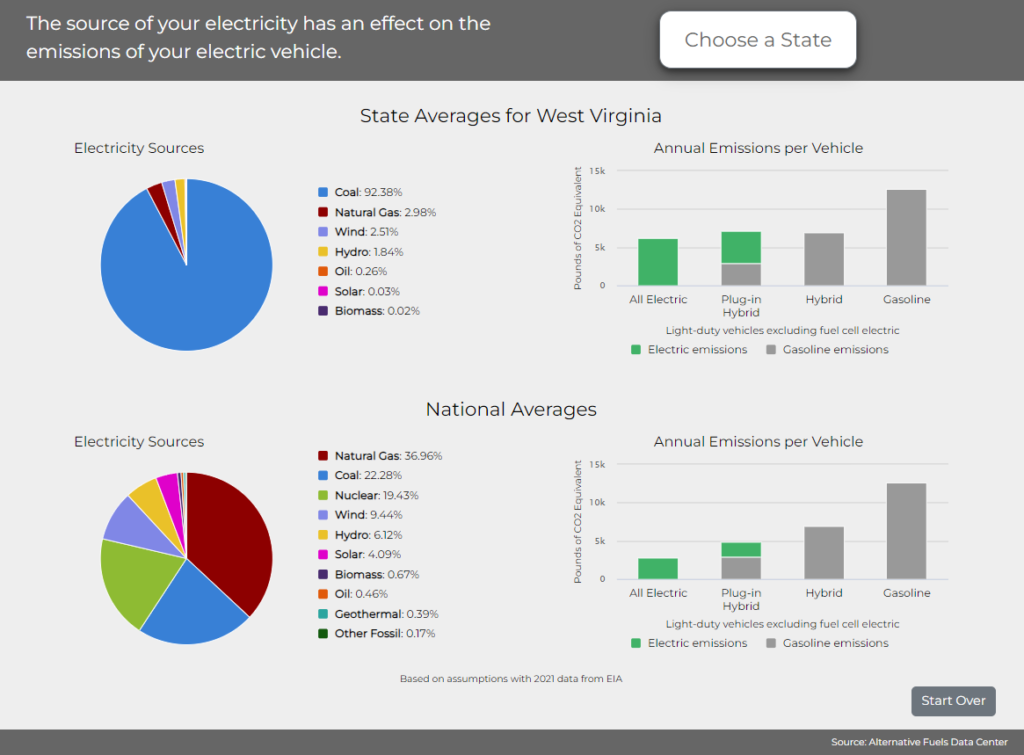
Indeed, the Department of Energy’s Alternative Fuels Data Center has a calculator that compares annual emissions by powertrain. Even in the most coal-heavy states like West Virginia and Wyoming, EVs (and plug-in hybrids) both have substantially lower emissions than ICEVs per annum.
Well, actually, when comparing EVs vs. ICEVs emissions, what should be looked at is the marginal emissions. But since the author didn’t bring it up, that’s outside of the scope here.
Regarding the second point, although Giambruno correctly points out that “extracting and processing the exotic materials needed to make EVs requires tremendous power” and that power mostly comes from hydrocarbons, the author did not substantiate how much hydrocarbon is consumed relative to the life-cycle of EVs.
Regarding the third point, the author did raise an important and valid point here: EVs require an enormous amounts of rare earth elements (REEs) and metals like lithium, cobalt, and nickel. Indeed, there are serious environmental and social justice issues around the mining of these elements. Mainstream media have already talked about lithium and cobalt mining’s devastating impacts on communities in countries such as Chile and DR Congo (e.g., the Guardian, the NYT, the NPR, the Verge, and the Financial Times).
Claim #2: EVs Can’t Compete Without Government Support
Although this author had some good criticisms questioning whether EVs are green, unfortunately, his next point is erred by numerous omissions, which makes this claim disingenuous at best and perhaps even misleading.
The $393 billion EV subsidy the author cited refers to the clean vehicle tax credits in the Inflation Reduction Act (Public Law 117-169). The bill text itself did not state that the EV subsidy will total $393 billion from 2022 to 2031; that figure is from the Penn Wharton Budget Model, which in turn is based on a recent Goldman Sachs report “Carbonomics: The Third American Energy Revolution” (redacted version; see Exhibits 3 and 36). Note that this $393 billion is Goldman Sachs’ own estimate, which is significantly greater than the Congressional Budget Office’s $14 billion estimate for EV tax credits (subtotals of Sec. 13401 – 13404).
Compared to the CBO’s estimate of $391 billion in total for all climate and energy programs over 2022 – 2031, Goldman Sachs’ estimated that the IRA could cost the government around $1.2trn through to 2032, three times the CBO estimate. But what is omitted in the International Man article is what immediately followed in Goldman Sachs’ report, i.e., “[t]his material government contribution would in turn unlock US$3trn of infrastructure investments to 2032 (a 2.5x multiplier vs c.$1.2trn government incentives).”
In other words, the author conveniently left out the infrastructure investments that would spur from the IRA.
The author also conveniently left out the part where the U.S. provides $10 billion to $50 billion per year in subsidies for fossil fuel (hydrocarbons), or $5.9 trillion globally in 2020.
But let’s focus on the meat of the claim, that EVs can’t compete without government support. Particularly, the author wrote that “[a]ccording to J.D. Power, a consumer research firm, the average EV still costs at least 21% more than the average gasoline vehicle.”
I don’t know which J.D. Power article the author was referring to (the author did not provide a link), but J.D. Power has several articles on the cost of EVs), including one where leased BEVs are more affordable than ICEVs and another one where BEVs are approaching cost parity with ICEVs over 5 years of ownership. If readers like me can’t tell where the claim “EVs still cost 21% more than average gasoline vehicle” comes from, then the author’s argument boils down to nothing more than “trust me, bro.”
Also, do you see a recurring theme here? Just as the author failed to provide life-cycle emissions comparisons in his previous claim that EVs are not green, here the author failed to provide life-cycle total cost of ownership comparisons or at least the total cost of ownership over a period of time.
Claim #3: EVs Are About Controlling You
The second claim is merely a baseless assertion, but the third and final claim sounds straight up like a fearmongering conspiracy hypothesis. Let’s unpack this.
The author claims that EVs control people because they are spy machines. That EVs collect an unimaginable amount of data on you, which governments can access easily.
But the author didn’t differentiate between EVs and ICEVs – what makes EVs spying machines that modern ICEVs aren’t? For example, the author wrote, “[h]ad the Canadian truckers’ vehicles been EVs, the government would have been able to stamp out the resistance much easier.”
But the problem is, the author did not explain just how the situation with the Canadians truckers would had turned out differently if they drove EV trucks instead of gasoline/diesel trucks. What are the components that are specific to EVs only (such as the battery cells) that make them prone to be spy machines? The article didn’t say.
By the way, modern ICEVs also collect “an unimaginable amount of data” on drivers. The sensors in automobiles — from telematics to fully digitized control consoles — have made them prodigious data-collection hubs. For example, cars have microphones that people have all sorts of conversations with and cameras that face inward and outward. These parts are present regardless of the vehicle powertrain. The Los Angeles Times has a recent article that talked about privacy concerns in automobiles.
If Giambruno can specifically identify and elaborate what makes EVs spying machines (that gasoline vehicles are not), I am all ears. But otherwise, this claim again boils down to “trust me, bro.”
]]>
In this NOI, DOE is seeking public input on the design of a demand-side support mechanism for the regional clean hydrogen hubs program. (In an earlier announcement, DOE plans to spend up to $7 billion to support 6 to 10 clean hydrogen hubs throughout the U.S.)
There is nothing wrong with wanting to provide additional support (Section 45V hydrogen tax credit, anyone?) to ramp up the market for clean hydrogen. The main issue is, the questions that DOE is asking are fundamentally economic questions, but DOE’s main bread and butter is early stage research and development.
And it shows in the NOI. The NOI has several uncertainties that make the economic feasibility of such support mechanism questionable. For example, the NOI did not specify who would be receiving the support (customers? end users? the hubs?) Depending on who receive the support, $1 billion ranges from very little to a mere drop in the bucket.
How little? In DOE’s recently published National Clean Hydrogen Strategy & Roadmap, the intermediate goal is to produce 10 MMT per year by 2030. That’s right: 10 billion kg by 2030. So that $1 billion amounts to 10 cents per kg… for a year. (For reference, DOE has a goal of reducing the cost of clean hydrogen to $1/kg in a decade [“1 1 1”]. Green hydrogen costs ~$5/kg today.)
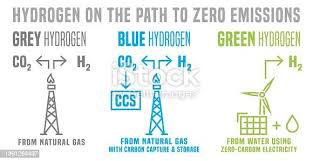
Another important consideration is these hubs are silo, which means they face little to no competition from each other presumably. The hubs will be a mix of blue hydrogen (using fossil fuels with carbon capture and storage), green hydrogen (electrolysis from renewable energy), or pink hydrogen (using nuclear energy). It is not clear how DOE will handle the competitive process. Right now, blue hydrogen is cheaper but dirtier than green and pink hydrogen; such a support mechanism might end up blocking the market entry of green/pink hydrogen.
Speaking of silo hubs, the initial market will likely be a captive market. How does a captive market affect demand stimulus? It is possible that it would end up limiting competition (which means a lower level of clean hydrogen on the market than intended.)
Finally, the NOI asked about the effectiveness of “pay-for-difference contracts“, which I will assume to be synonymous to “contract-for-difference” or CfD. A CfD is a private law contract between a vendor and a customer at an agreed fixed price for a number of years. (Disclaimer: I am not a lawyer and know nothing about financial, commodity, or energy laws.) The energy generation market in the U.K. is perhaps the most well-known example of CfD application. While CfD is the British government’s main mechanism for supporting low-carbon electricity generation, it is banned in the U.S. (see Security and Exchange Commission v. 1Pool Ltd.) It isn’t clear in the NOI whether DOE has considered potential legal issues that could arise from implementing a CfD scheme (where do you draw the line between financial instruments and commodities? Is energy in an energy market considered a commodity? What about commodity derivatives?)
Ultimately, if DOE is concerned that there might not be enough demand or offtakes or hydrogen hubs’ competitiveness, perhaps it might be more effective to help the hubs directly?
]]>