Notice: Function _load_textdomain_just_in_time was called incorrectly. Translation loading for the mailpoet domain was triggered too early. This is usually an indicator for some code in the plugin or theme running too early. Translations should be loaded at the init action or later. Please see Debugging in WordPress for more information. (This message was added in version 6.7.0.) in /home/yxucktnn/public_html/wp-includes/functions.php on line 6131

Notice: Function _load_textdomain_just_in_time was called incorrectly. Translation loading for the inspiro domain was triggered too early. This is usually an indicator for some code in the plugin or theme running too early. Translations should be loaded at the init action or later. Please see Debugging in WordPress for more information. (This message was added in version 6.7.0.) in /home/yxucktnn/public_html/wp-includes/functions.php on line 6131

Warning: Cannot modify header information - headers already sent by (output started at /home/yxucktnn/public_html/wp-includes/functions.php:6131) in /home/yxucktnn/public_html/wp-includes/feed-rss2.php on line 8
Renewable Energy – Clean Economy Chronicles https://cechronicles.com Economics. Energy. Innovation. Strategy. Sat, 22 Jun 2024 19:04:44 +0000 en-US hourly 1 https://wordpress.org/?v=6.9.4 https://cechronicles.com/wp-content/uploads/2023/07/cropped-Screen-Shot-2023-07-28-at-22.01.01-32x32.png Renewable Energy – Clean Economy Chronicles https://cechronicles.com 32 32 Tracking the Latest California Climate and Energy Bills https://cechronicles.com/index.php/2024/02/29/tracking-the-latest-california-climate-and-energy-bills/ https://cechronicles.com/index.php/2024/02/29/tracking-the-latest-california-climate-and-energy-bills/#comments Thu, 29 Feb 2024 15:21:29 +0000 https://cechronicles.com/?p=382 Read more "Tracking the Latest California Climate and Energy Bills"

]]>

February is the month when lawmakers in California introduce new bills to the new session.  Each year, thousands of bills are introduced, but only a select few make it to law. Even as a state with front-running climate and energy policies, it is no exception. This post will discuss some of the notable bills introduced.


Solar (mostly rooftop solar PV)

The hottest topic on solar energy policy in California is hands down the implementation of NEM3.0 that went into effect in spring 2023. the revised rate structure lowers compensation for exported solar production by about 75%. As a result, California’s rooftop solar market slowed down significantly since NEM3.0’s implementation. Since NEM3.0 went into effect, rooftop solar sales decreased between 66 and 83% compared to the same time in 2022, according to a California Solar Storage Association survey.

AB2256: Public utilities: low-income customers (Friedman, D-44).

Summary: An act to amend Section 382.1 of the Public Utilities Code, relating to public utilities, AB2256 would make non-substantive changes to provisions relating to the Low-Income Oversight Board. The Low-Income Oversight Board advises the CPUC on low-income electricity, gas, and water customer issues and to serve as a liaison for the commission to low-income ratepayers and representatives. AB2256 would require the CPUC to fully consider the costs and benefits (such as better local air and water quality, avoided land use impacts, and associated system cost benefits) of rooftop solar when revisiting its net energy metering (NEM) tariff.

Importance: AB2256 would boost rooftop solar by including environmental and societal benefits in the way the CPUC calculates its value. In California, NEM3.0 went into effect in spring 2023, where the revised rate structure lowers compensation for exported solar production by about 75% and makes batteries an essential component of a residential solar project. As a result, California’s rooftop solar market slowed down significantly since NEM3.0’s implementation.  

AB2619: Net energy metering (Connolly, D-12).

Summary: An act to amend Sections 2827 and 2827.1 of, and to add Section 2827.2 to, the Public Utilities Code, relating to energy, AB2619 would direct the California Public Utilities Commission to reconsider the rooftop solar reimbursements it slashed by about 75 percent in 2023. In other words, AB2619 would repeal NEM3.0 and supports California’s rooftop solar market.

Importance: AB2619 would direct CPUC to make sure reimbursements are big enough to drive a doubling of rooftop generation by 2045 in accord with state renewable energy goals. Naturally, the solar industry such as SEIA welcomes the bill. But the old problems would come back, namely, those who are not well-off enough to afford rooftop solar would be subsidizing affluent homeowners. 

SB1118: Solar on Multifamily Affordable Housing Program (Eggman, D-5)

SB1190: Mobilehomes: solar energy systems (Laird, D-17)

SB1508: Solar energy: multifamily housing (Stern, D-27)

Note: These bills are incomplete as of writing. These bills are known as “spot” measures, which are missing policy details and could be fleshed out at any time.

Summary: SB1118 would attempt to enact future legislation relating to the Solar on Multifamily Affordable Housing Program. SB1190 would allow a homeowner or resident to install a solar energy system on their mobile home. SB1508 would facilitate the installation of solar energy systems and solar energy storage technologies in multifamily housing. Not much is known about this bill currently.

Importance: One glaring theme of residential energy policy in the U.S., whether it be the federal Weatherization Assistance Program or California’s NEM, is that multifamily housing units (e.g., apartments and condos) tend to be an afterthought. Existing programs and policies are designed with single-family households in mind, a reflection of American cultural preference, where owning a single-family detached residence is the pinnacle of the American Dream. In an apartment building where the occupants (instead of the landlords) are responsible for paying their own electric bills, the landlords have just about no incentive to install solar energy systems.

Offshore Wind

Compared to solar and hydrogen, fewer bills related to wind (especially offshore wind) have been introduced. California has the potential to be a leader in offshore wind deployment but faces several hurdles.

AB2208: Offshore wind energy projects: bond act (Zbur, D-51)

Summary: AB2208 would enact legislation to submit to the voters an act authorizing the issuance of general obligation bonds in the amount of $1 billion for seaport infrastructure improvements to facilitate offshore wind energy projects off the California coast.

Importance: A bond could help kickstart offshore wind development, but California has a recent history of mismanaging billions of dollars of housing bonds to tackle the housing shortage. In a state where rampant NIMBYism runs strong, the state simply lacks strong enough laws and oversight to ensure that cities and counties are doing their part to build affordable housing. There is little reason thus far to expect a different, more positive outcome for offshore wind bonds such as the one AB2208 is proposing.

Hydrogen

Hydrogen could play an important role in California’s climate transition. As one of the seven hubs funded by the Department of Energy $7 billion H2Hubs program, ARCHES is California’s initiative to accelerate renewable hydrogen projects and the necessary infrastructure. This year sees some bills that would pick up from where AB1550, which would have imposed strict rules on how and where hydrogen production facilities get their molecules, left off. As 2023’s most ambitious hydrogen bill, AB1550 died out last year’s after much fanfare.

SB993: Clean energy development incentive rate tariff (Becker, D-13)

Summary: SB993 would require the CPUC to establish a clean energy development incentive rate time-of-use tariff to encourage the development of new commercial or industrial electrical loads that contribute to the state’s efforts to reduce the emissions of greenhouse gases. In layman terms, this means SB993 aims to boost clean hydrogen production in California and protect the grid at the simultaneously by adjusting the price of electricity for hydrogen producers throughout the day.

Importance: Additionality is a concept that diverting existing clean electricity to make hydrogen will cause emissions to increase by forcing grid operators to draw more heavily upon fossil energy (natural gas usually) to make up the difference. Given that ARCHES plan to produce clean hydrogen using renewable energy and biomass, SB993 seems to make a lot of sense. 

SB1018: Electrical corporation: definition: exclusion of certain solar or wind generating technologies (Becker, D-13)

Summary: SB1018 would revise the definition of “electrical corporation” to exclude a corporation or person employing certain solar or wind generating technology that uses the energy only for an electrolyzer technology facility that produces hydrogen from water or a facility using the electricity to provide industrial process heat, but not for departing electric load. In other words, SB1018 would enable firms and people to start generating and using their own energy to produce hydrogen or industrial process heat rather than purchasing it through the electrical grid.

SB1420: Hydrogen (Caballero, D-14, Archuleta, D-30, Dodd, D-3, and Newman, D-29)

Summary: SB1420 proposes many changes, but the most notable one is that the bill would treat hydrogen more like wind and solar on the state grid by qualifying it to count toward utilities’ renewable energy buying requirements, for purposes of the California Renewables Portfolio Standard Program. In addition, SB1420 would also qualify hydrogen for the permit streamlining that Gov. Gavin Newsom created for wind, solar and other resources in 2023. SB1420 would also require California Air Resources Board to adopt regulations requiring:

1.) No less than 33.3% of retail hydrogen produced for or dispensed by fueling stations that receive state funds to be made from renewable hydrogen;

2.) No less than 60% of retail hydrogen produced or dispensed in California for use in transportation is made from renewable hydrogen by December 31, 2030; and

3.) By December 31, 2045, the remainder of retail hydrogen produced or dispensed in California for use in transportation is made from a mix of renewable hydrogen and clean hydrogen.

]]>
https://cechronicles.com/index.php/2024/02/29/tracking-the-latest-california-climate-and-energy-bills/feed/ 2
Why California is (not) Ready for Offshore Wind (Part 1) https://cechronicles.com/index.php/2023/08/28/why-california-is-not-ready-for-offshore-wind/ https://cechronicles.com/index.php/2023/08/28/why-california-is-not-ready-for-offshore-wind/#comments Mon, 28 Aug 2023 02:53:56 +0000 https://cechronicles.com/?p=205 Read more "Why California is (not) Ready for Offshore Wind (Part 1)"

]]>
After two decades of aggressive investments in renewable energy, California leads the United States in renewable energy deployment. Since 2010, however, most of the additional deployment have been concentrated in solar PV followed by land-based wind. In recent years, the Golden State has finally turned its sight on offshore wind. But is it ready?

Image generated by AI

California has one of the longest coastlines (3rd longest per CRS and 5th longest per NOAA), making it an ideal state for offshore wind deployment on paper. The Golden State also has clean energy goals (e.g., Senate Bill 100, Assembly Bill 2514) and is home to the largest cleantech investment ecosystems. Not to mention that offshore wind can help California diversify its clean energy portfolio (which is dominated by solar PV since its landmark climate bill AB 32 was signed into law in 2006.) By embracing offshore wind energy, California can make substantial progress toward its renewable energy goals, create jobs, enhance energy security, and contribute to global efforts to combat climate change. These conditions make it a no-brainer for California to aggressively pursue offshore wind.

Or is it?

There exist concerns and issues such as those on wildlife habitats, grid integration, and permitting and regulatory that California need to address.

Environmental and Ecological Concerns

California’s coastal waters are ecologically diverse and home to various marine species. Offshore wind projects can potentially impact marine ecosystems, migratory routes of marine animals, and even local bird populations.

The following maps show California’s national marine sanctuaries and the biological habitat areas off California’s coastline. As you can see, the only area(s) that might not encroach the natural habitats would be the coasts off of rural Northern California, a part of Central Coast, and Southern California.
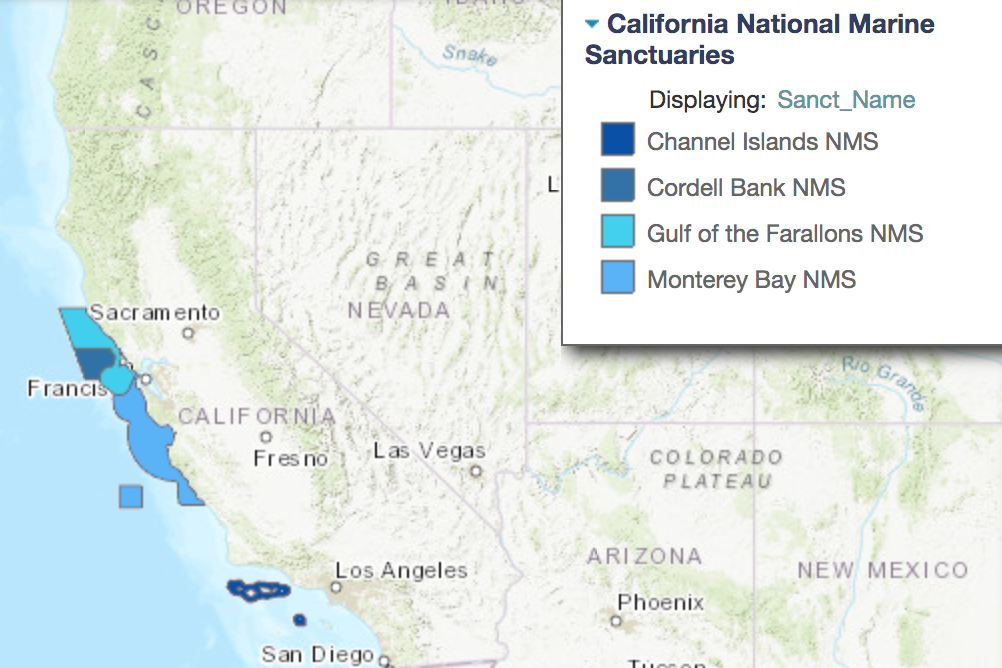
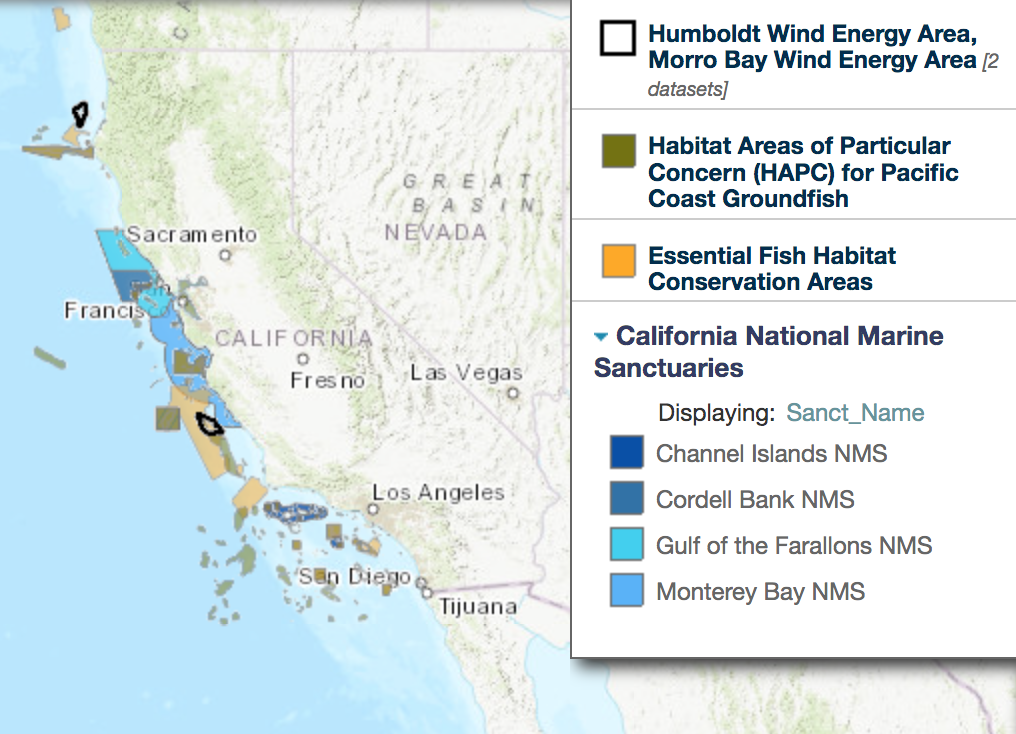
Source: Conservation Biology Institute; California Energy Commission

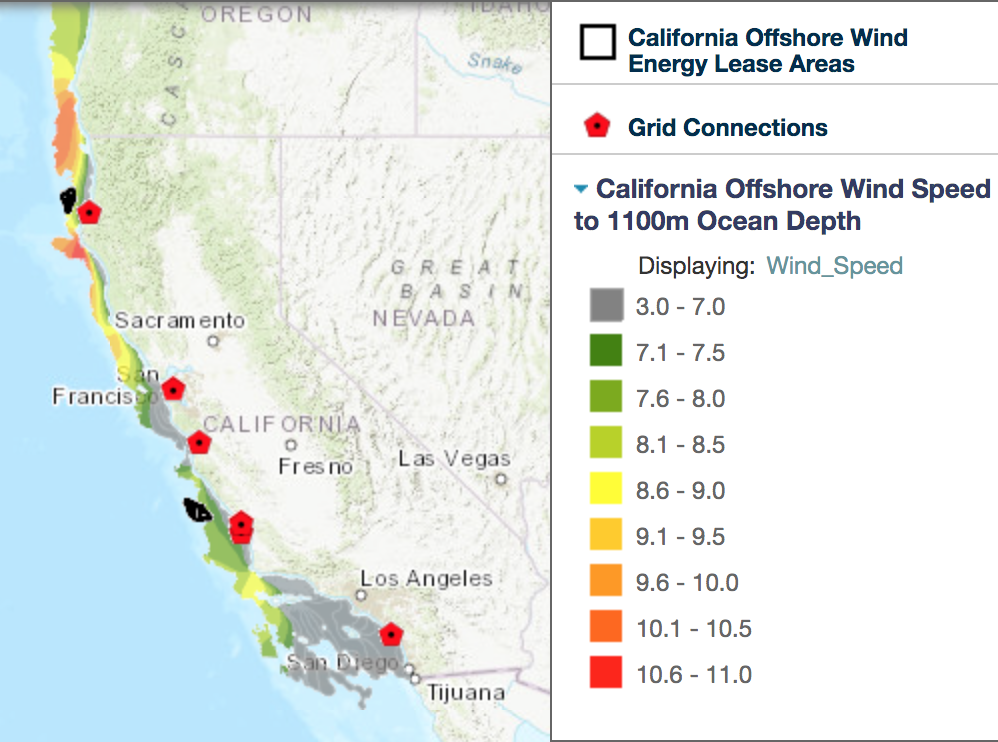
But looking at the offshore wind speed, it is immediately apparent that Southern California has low wind speed, which means that region is not really suitable for deploying offshore wind.

That leaves parts of Central Coast (off of San Luis Obispo County) and rural Northern California (particularly Humboldt County).

Grid Integration Concerns

Integrating offshore wind energy into California’s existing power grid poses technical challenges. The transmission infrastructure needs to be upgraded to transport the electricity generated offshore to where it’s needed onshore. Nationally, the grid is woefully outdated and there are not enough transmission lines to support the transition from a fossil fuel-based electric system to a decarbonized energy grid. About 70% of the grid is more than 25 years old, which can be vulnerable to increasingly intense storms.
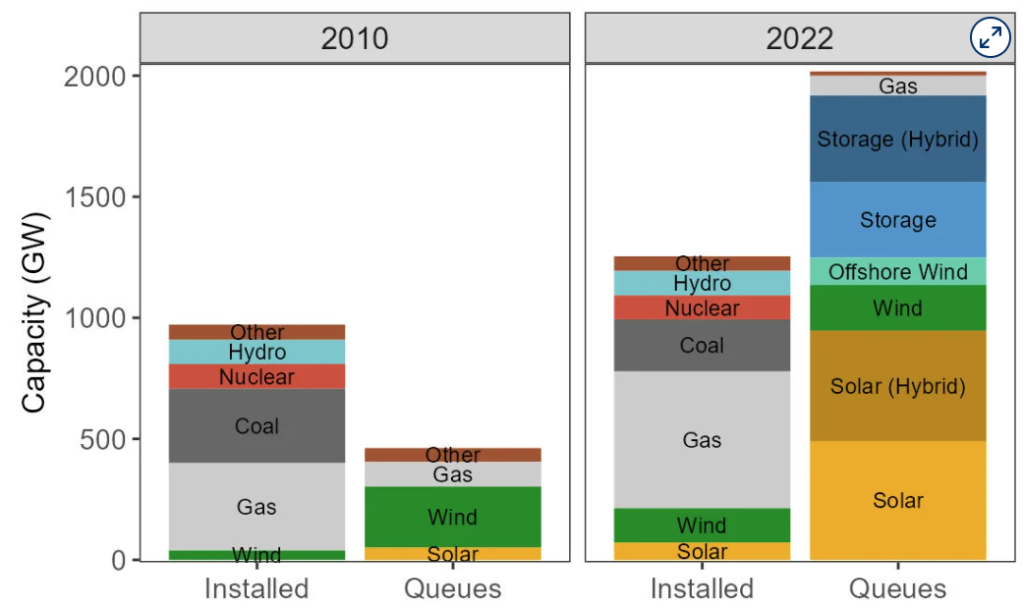
Entire U.S. Installed Capacity vs. Active Queues. Source: Rand et al. (2023). “Queued Up: Characteristics of Power Plants Seeking Transmission Interconnection.” Lawrence Berkeley National Laboratory. Available at: https://emp.lbl.gov/sites/default/files/queued_up_2022_04-06-2023.pdf

Per the LBNL study (2023), as of the end of 2022, the total capacity active in the queues is growing year-over-year, with >2,000 GW of generation and storage capacity. About half of that are from solar and solar (hybrid). About 150 GW of offshore wind is in active queue capacity.

Another hurdle is the need to balance the intermittent nature of wind energy with the grid’s stability. So far, besides some fundings from the recently climate landmark bills, not much has been done at both the federal and state levels to effectively solve these issues that are decades in the making.

Permitting and Regulatory Concerns

To connect a new source of power to the U.S. electric grid requires energy generators to go through an application process with a regional transmission authority or utility. The interconnection process starts with a request to connect to the grid, which officially enters the power generator in the interconnection queue. Next is a series of studies (e.g. feasibility, system impact and facilities studies) where the grid operator determines what equipment or upgrades will be necessary to get the new power generation on the grid and what it will cost.

Remember that there are not enough transmission lines and renewable energy power generators are waiting to be connected to the grid? To complicate the picture further, interconnection application process is often time consuming and requires upgrades to the grid, which are often so costly that power generators have to back out.

Indeed, of the almost 30,000 observations (year project entered queue range = 1995 to 2022) included in the LBNL study, nationwide, about half of the proposed projects are withdrawn, with another 35% currently in active queue or suspended. Just 13% of these projects are operational.

Of the 15 projects for offshore wind or offshore wind + battery (these entered queue between 2018 to 2021) in CAISO, 6 are in active queue and 9 have been withdrawn. This means none of these projects have yet become operational. (In the LBNL dataset, only one offshore wind project has come online nationwide. It entered queue in 2013 and became operational in 2020.)

Make no mistake, permitting bottleneck is a pervasive problem plaguing energy projects nationwide. But the problem seems more acute in California. Outside of CAISO, 3/4 of the projects in the dataset took fewer than 5 years from entering the queue to becoming operational. But just 38% of the projects in CAISO jurisdiction took fewer than 5 years to become operational. On the other hand, 1/5 of the projects in CAISO took at least 8 years to come online compared to just 4% of the projects in other regions.
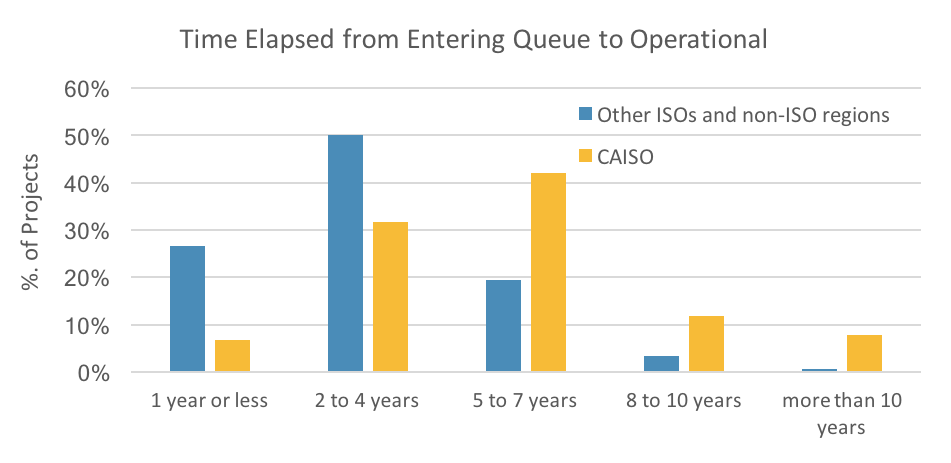
Source: Author’s tabulation of LBNL dataset

Needless to say, California’s long process means projects that do come online come at later dates than anticipated. These delays often translate to additional project costs. In fact, almost 1/5 of these projects faced a delay of 5 or more years.
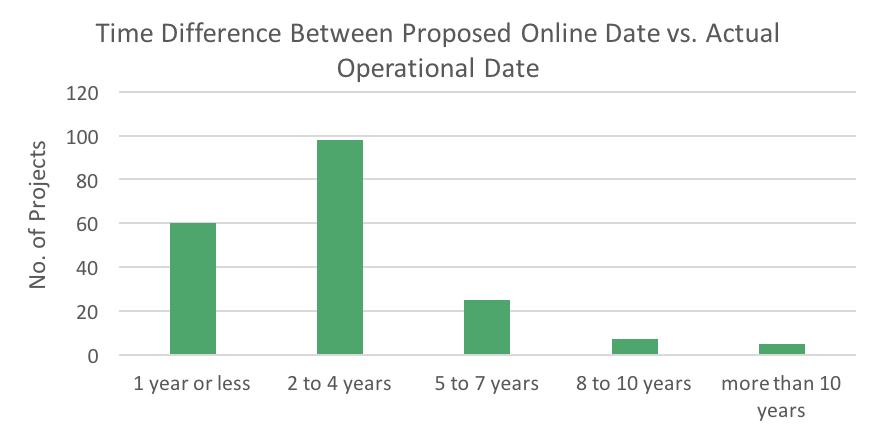
Source: Author’s tabulation of LBNL dataset

California’s burdensome permitting and regulatory environment don’t just apply to energy projects. The state is also famously known for its long and drawn-out processes and CEQA litigations on housing development and infill projects. These issues often make an already expensive project even most cost prohibitive.

Stay tuned for part 2.

]]>
https://cechronicles.com/index.php/2023/08/28/why-california-is-not-ready-for-offshore-wind/feed/ 4