All Aboard the Hydrogen Hubs Hype Train
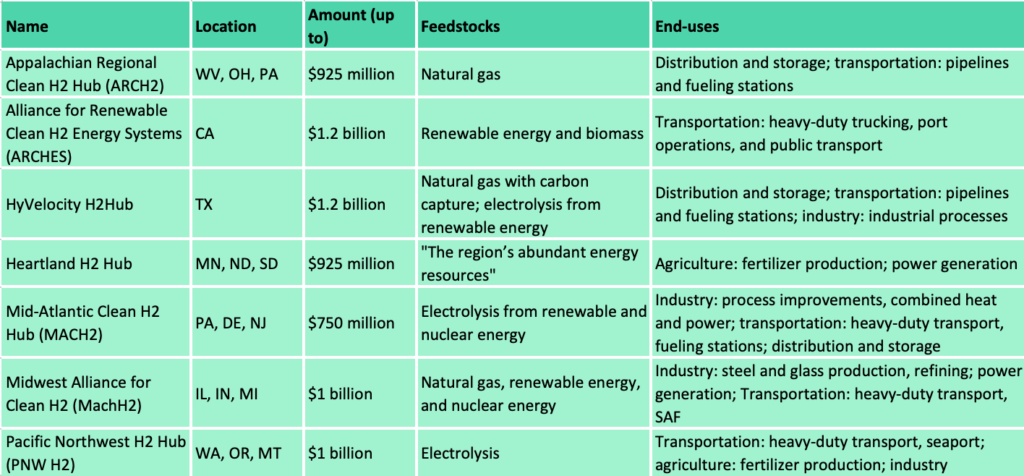
The U.S. Department of Energy (DOE) on Friday announced its selection of 7 much anticipated regional hydrogen hubs (H2Hubs), totalling $7 billion in awards. These hubs are located in various parts of the U.S.—the Appalachia, California, the Gulf Coast, the Northern Great Plains, the Mid-Atlantic, the Midwest, and the Pacific Northwest. Collectively, these hubs are expected to produce a collective three million metric tons of hydrogen annually—30% of DOE’s 10 million metric tons/year goal by 2030.
The following table summarizes these 7 H2Hubs:
Hydrogen can be produced from diverse domestic resources and used across sectors. Production can be centralized or decentralized, grid-connected or off-grid, offering scalability, versatility, and regionality. Hydrogen can be produced from several technology pathways, feedstocks, and have several potential end-uses. It is no wonder that the Biden administration is all-in on the hydrogen hype train.
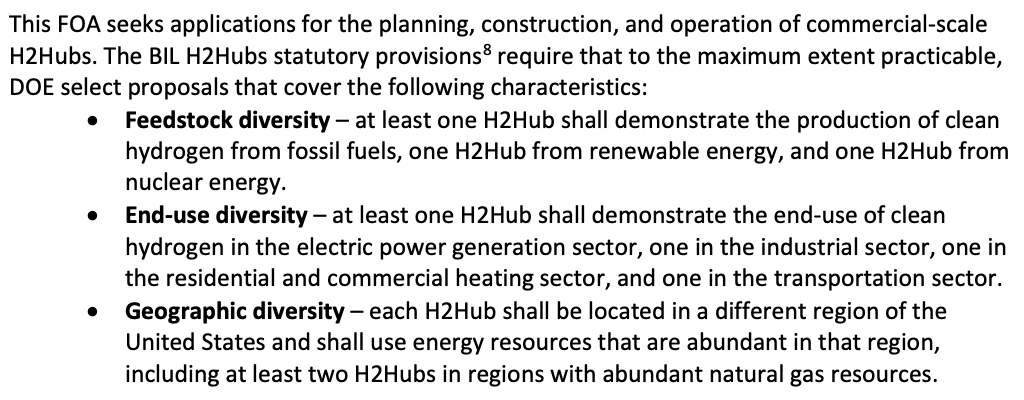
Recall that the funding opportunity announcement (DE-FOA-0002779) has three selection criteria focused on diversity: feedstock diversity, end-use diversity, and geographic diversity (see excerpt above). At first glance, the selected H2Hubs have covered these three fronts very well. But is that the whole story?
Hydrogen Hubs: A Cash Grab for Big Oil and Gas?
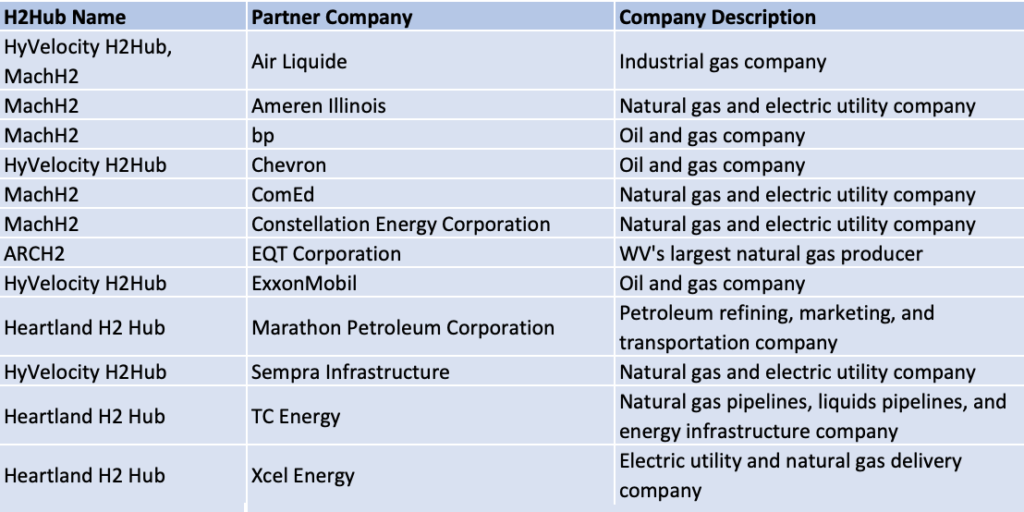
4 out of 7 H2Hubs (ARCH2, HyVelocity H2Hub, Heartland, and MachH2) will produce hydrogen using natural gas, a fossil fuel. This means over half of the H2 hubs will produce so-called blue hydrogen (using fossil fuels with carbon capture and storage). Right now, blue hydrogen is cheaper but dirtier than hydrogen produced from electrolysis from renewable energy and nuclear energy. Of these hubs, ARCH2 will produce hydrogen exclusively from fossil fuel.
Indeed, industry partners backing these 4 hubs include major oil and gas companies. See the table below.
Unfortunately, even the hubs that plan to produce hydrogen using electricity generated from renewable energy and/or nuclear energy aren’t blameless either. In a previous post, I wrote that a lot of renewable energy are waiting to be interconnected due to grid backlog. the grid is woefully outdated and there are not enough transmission lines to support the transition from a fossil fuel-based electric system to a decarbonized energy grid. This means the H2Hubs that plan to produce hydrogen from electrolysis should not divert clean energy from the grid. Otherwise emissions from electricity generation would increase.
Except for ARCH2, these hubs plan to use several methods for hydrogen production, but the exact mix may change depending on which projects make it through the DOE negotiations process. Although the Biden administration has emphasized that roughly two-thirds of the $7 billion pot is associated with the production of hydrogen from renewable energy, it’s too early to tell what the final result would look like (these hub demonstrations will run until around 2032, providing that they meet the milestones set by DOE.)
The next post will look at the end-uses proposed by these hubs.
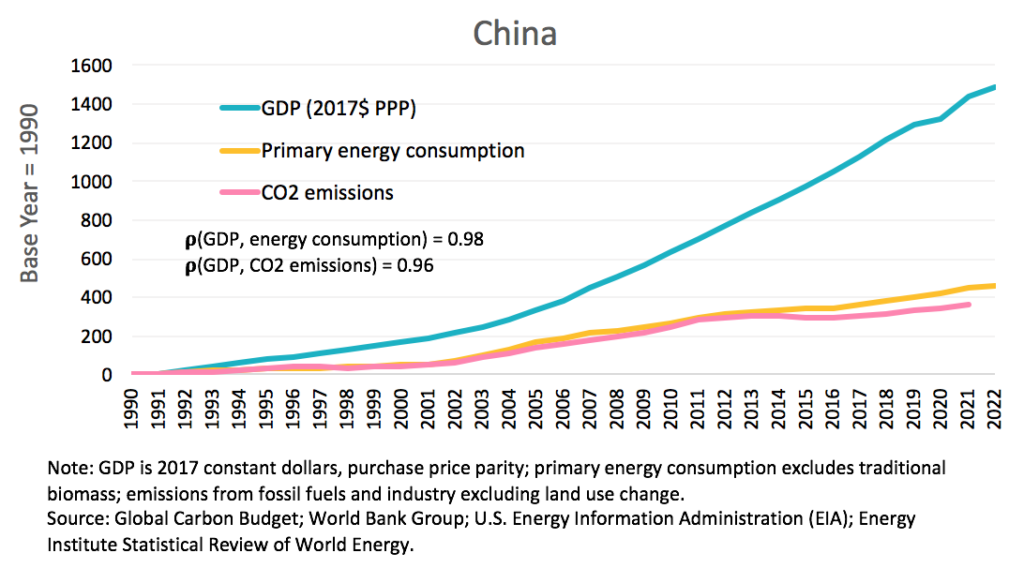
]]>Historically, it has been famously difficult to decouple economic growth and energy consumption. For example, China’s impressive economic growth (and hence a substantial rise in the Chinese’ standard of living) in this century has been coupled with an increase in energy consumption of equally great magnitude. And with that a rapidly rising greenhouse gas emissions. Although global leaders have been talking about the need to decarbonization for decades, unfortunately GHG emissions along with the cost of climate mitigation and adaptation continue to go up with no signs of slowing down.
In a world where information travels instantaneously and where we live in an increasingly chaotic U.S. political and global geopolitical environment, it seems dire out there. Nonetheless, the energy transition is happening across every economic sector, albeit at an uneven pace where the outcome is often unjust.
CEC is dedicated to chronicling the economy and clean energy in a larger social context. A clean economy for the people and by the people.
About Me
My background lies in the intersection of economics and energy.
I have been reading, thinking, commentating, and documenting about the intersection of economics and energy for over a decade. Although I am an economist by training, my career has mostly been in between sustainability, clean energy innovation and deployment, and economic development.
My work has been editorially featured or cited on the Wall Street Journal, S&P Global, GovTech (here and also here), RealClearEnergy (here and also here), Politico/E&E News (here and also here), Utility Dive, CalMatters, and other media.
My goal is to provide institutional-level research in plain English, so that layman, policy wonks, professional practitioners can benefit from it. But what I want to do most of all, is give you clear information and analysis.
]]>