Recently, the Department of Energy (DOE) posted a request for information (RFI) regarding the development of green shipping corridors (GSCs) between the United States and the United Kingdom (DE-FOA-0003156). The purpose of the RFI is to solicit feedback from maritime stakeholders on issues related to the establishment of green shipping corridors between the U.S. and the U.K.
We are pleased to submit our comments regarding the U.K.-U.S. GSCs. This post summarizes the main points raised in our filing.
Read the filing below.
What are Green Shipping Corridors?
Green shipping corridors are maritime routes that showcase zero- and near zero- emission lifecycle fuels and technologies with the ambition to achieve zero greenhouse gas emissions across all aspects of the corridor in support of sector-wide decarbonization no later than 2050.
The concept of GSCs debuted back in COP26 as part of the First Movers Coalition. This means decarbonization of the maritime sector was NOT part of the Paris Agreement in 2015.
Ideally, Green shipping corridors should lay the ground for the massive reductions that will happen once these solutions roll out globally. Within the purview of this RFI, if the U.K.-U.S. partnership is successful, then ultimately zero-emission shipping should be a commercially viable option that can be deployed anywhere and not just on certain routes by 2030.
Challenges and Barriers
There are several challenges and barriers for a green shipping corridor between the U.S. and U.K.
Regarding technology barriers, uncertainty on the fuel pathways persists at the global level, and there is no clear alternative fuel of choice (unlike, say, sustainable aviation fuel for the aviation sector). Innovation must stimulate the further development of several fuel options to support a multi-fuel mix future suitable for different modes of operation and geography. But existing constraints on time and investments imply that it may be infeasible and impractical to place many bets.
Regarding policy challenges, some of them involve vessel types and implementation challenges. Currently, most of the proposed green shipping corridors focus primarily on container ships, but these are “low hanging fruits” that are relatively easier to decarbonize and comprise less than a quarter of the maritime sector’s total emissions. Furthermore, DOE should consider carefully whether it wants to implement a phased approach or go for zero- and near-zero emission demonstrations immediately. While a phased approach may ease the transition, relying on fossil fuels during an interim period may jeopardize the sector’s ability to fully decarbonize by 2050.
Regarding regulatory challenges, it is not certain whether the two countries are on the same page regarding the life-cycle assessment of shipping emissions. As a parallel, for sustainable aviation fuel (SAF), Argonne National Lab’s GREET model and the International Civil Aviation Organization’s CORSIA have different estimates of SAF’s life cycle emissions. And then there’s the Jones Act, the century old law that restricts water transportation of cargo between U.S. ports to ships that are U.S.-owned, U.S.-crewed, U.S.-registered, and U.S.-built… how will the U.K. deal with the Jones Act?
]]>
Aviation accounts for 2% of global energy-related CO2 emissions. Without significant policy intervention, emissions from international aviation could triple in 3 decades. Perhaps this sense of urgency is why Sustainable Aviation Fuel (SAF) is getting so much attention lately.
Internationally, the multilateral Carbon Offsetting and Reduction Scheme for International Aviation (CORSIA) is a 3-phase program administered by the International Civil Aviation Organization (ICAO). CORSIA has approved several SAF pathways for use in compliance.
The U.S. Department of Energy (DOE), the U.S. Department of Transportation (DOT), the U.S. Department of Agriculture (USDA), and other federal U.S. government agencies launched the SAF Grand Challenge in September 2022 to develop a comprehensive strategy for scaling up new technologies to produce SAF on a commercial scale. International NGOs, advocacy organizations, airlines, and other private sector stakeholders have followed suit voicing and pledging their support for SAF up-ramp.
SAF is an integral part of DOE’s Clean Fuels & Products Shot, the newest Energy Earthshots Initiative. Currently, few decarbonization options exist for the aviation industry, and these options are costly compared to conventional jet fuels. Some of these options such as batteries and liquid hydrogen fuel are far from commercially ready and are limited for small and short-haul flights due to their low gravimetric and volumetric densities. Meanwhile, SAF is jet fuel produced from sustainable feedstock (e.g., waste resources, cellulosic biomass, and captured carbon) and has a much lower carbon footprint than fossil-based jet fuels. In addition, SAF is a drop-in fuel that can be blended with other fuel types without any changes to aircraft design or existing infrastructure (unlike battery or hydrogen).
There are many production pathways for SAF, but not all have been approved by the American Society of Testing and Materials (ASTM) for drop-in use in aviation or by CORSIA for compliance. The following table describes some of these production pathways, feedstocks, technology readiness, and greenhouse gas (GHG) emission reduction potentials.
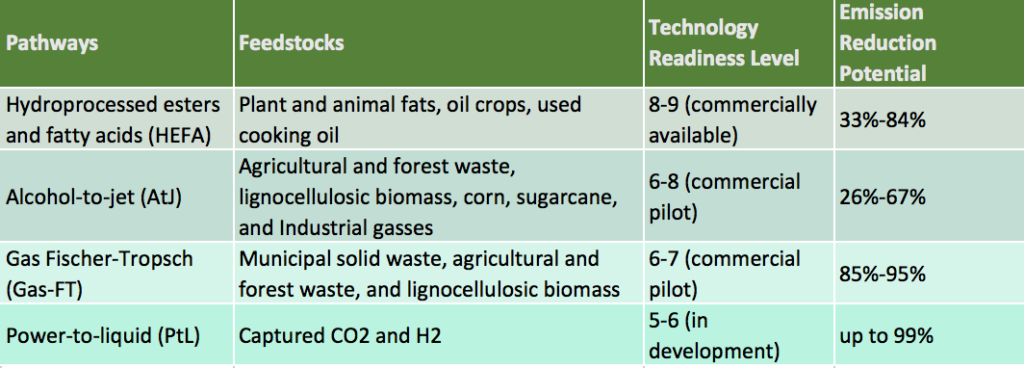
As one might infer from the table, with the exception of PtL, most of these production pathways involve using oils, fats, wastes, plants composed mainly of cellulose, hemicellulose, and lignin (lignocellulosic biomass), and starchy and sugary crops like sugarcane and corn.
Despite having many different feedstocks, aside from costs, feedstock constraints (and hence the lack of supply) is the biggest challenge to scale up and widespread commercial adoption. SAF is a nascent industry. There were no SAF in production as recently as 2015. Presently, SAF makes up a tiny share (~0.1%) of global jet fuel consumption. The International Air Transport Association (IATA) estimated that SAF production reached 79 million gallons (300 million liters) in 2022 while jet fuel consumption was 95 billion gallons (360 billion liters) pre-COVID 19. DOE’s SAF Grand Challenge has the goal of scaling SAF production to 3 billion gallons (11 billion liters) per year in 2030 and 35 billion gallons (132 billion liters) per year in 2050. There is a huge potential market for SAF.

Naturally, SAF has gathered substantial attention and interests from folks in the energy industry. But SAF also provides a prime opportunity for greenwashing. Meet the powerful corn lobby.
Does anyone remember the Renewable Fuel Standard and how corn-based ethanol was touted as the bridge to the next generation “advanced biofuel” during the Obama Administration? The debate on whether corn ethanol is climate friendly is a contentious topic. Early life-cycle assessments from the 2000s suggested that corn ethanol would produce 20% lower GHG emissions than gasoline. More recently, a 2021 Argonne National Lab study estimated that U.S. corn ethanol has 44%–52% lower GHG emissions than gasoline due to increased corn yields per acre, decreased fertilizer use, and improved ethanol production processes. On the other hand, a 2022 study by the Proceedings of the National Academy of Sciences contradicts previous research and found that ethanol is likely at least 24% more carbon-intensive than gasoline due to emissions resulting from land use changes to grow corn, along with processing and combustion.
All that is to say, factors such as land use and land use changes, changes in the production process and production level of nitrogen fertilizers, yield changes, and fuel market rebound effect–which can be hard to impossible to measure accurately–make accounting the true LCA of emissions from corn ethanol difficult.
Similarly, LCA (and techno-economic analysis or TEA) are inconsistent across the SAF industry. Furthermore, The LCA of pathways that are not fully developed may also have a high level of uncertainty that is not expressed in the model output. These two points are reflected by the large estimation range of GHG emission reductions in the table above.
To further complicate the picture, in the U.S., there is no standardized methodology on determining SAF’s life-cycle emissions. The 2021 ANL study referenced above uses the Greenhouse gases, Regulated Emissions, and Energy use in Technologies (GREET) model that it developed for LCA modeling of corn ethanol and other biofuels. Meanwhile, ICAO has its own methodology for modeling SAF’s life-cycle emissions under CORSIA (ICAO CORSIA). All else equal, ICAO CORSIA’s estimates tend to be less rosy than GREET’s due to the differences in how both methods account for cropland pasture to corn cropping conversion and carbon sequestration from agricultural management practices.
And this is not even taking other externalities into account. For example, the IPCC’s 2022 AR6 Working Group III report concluded that the increased demand for biofuels, coupled with the finite availability of land and growing demands for food, feed, and fuels, food-and-feed crops may be redirected to biofuel markets, thereby creating a domino effect as agriculture expands to replace this loss (indirect land-use change).
Before the U.S. charges ahead with SAF production scale up, shouldn’t it first figure out its actual emission reduction potential?
]]>