As local, state, federal government, and supranational agencies are racing against time to reduce greenhouse gases, ammonia is gaining attention as a “green” fuel for decarbonizing the transportation sector. But so far, much of that attention on ammonia’s applications has been limited to the marine transportation sub-sector.
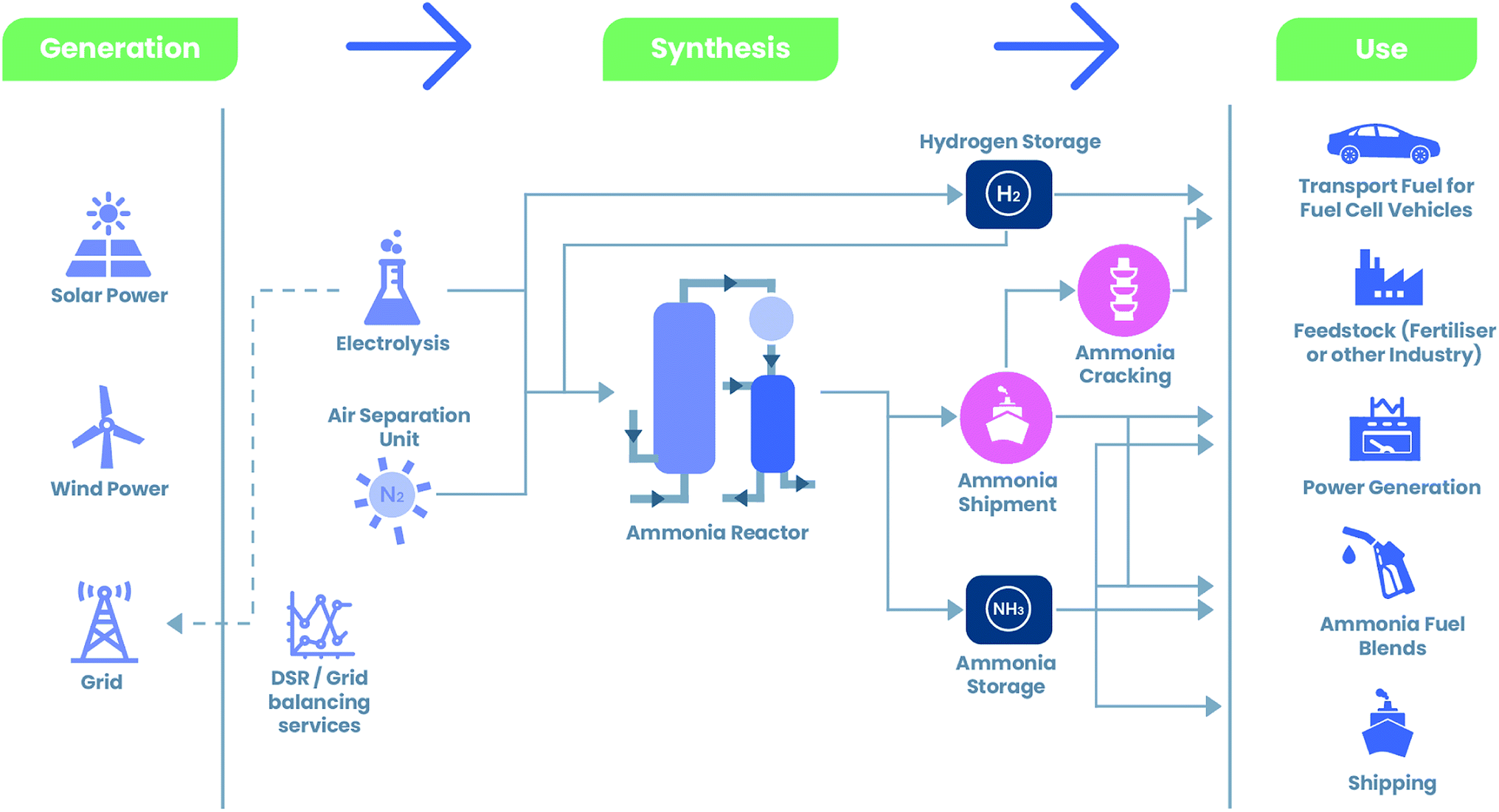
Ammonia (NH3) is produced by combining gaseous hydrogen with nitrogen from the air. Large-scale ammonia production uses natural gas for the source of hydrogen (grey hydrogen). However, if the market for clean hydrogen takes off, ammonia can be produced cleanly as well.
To be clear, ammonia fueled engines and vehicles are not new. During World War II, Ammonia (liquid anhydrous ammonia) was used to power buses in Belgium. Around the same time, the Gazamo process (burning a mix of ammonia and hydrogen in internal combustion engine) appeared to be the first application on a large-ish scale, with about 100 vehicles equipped for use of ammonia as fuel.
In the 1960s, the U.S. Military funded the Energy Depot Project, which explored developing alternative fuels (hydrogen, ammonia, and hydrazine) from indigenous materials (water, air, earth) but concluded that as long as hydrocarbons (e.g., gasoline, diesel, kerosene) are available, there was no incentive to use alternative fuels.
Recently, Toyota unveiled a 2-liter, 161 horsepower ammonia powered engine. Built in collaboration with Chinese automaker GAC Motor, the engine is touted to be a revolutionary breakthrough that will end EVs. To make the ammonia engine clean enough to use, Toyota and GAC had to cut nitrogen emissions, which was achieved in part due to an increase in combustion pressure.
There is also something in the works for heavy-duty trucking. Amogy, a cleantech startup that specifically aims to use ammonia to enable the decarbonization of the hard-to-abate sectors, unveiled the world’s first ammonia-powered semi-truck in early 2023. The 300kW semi-truck has 900 kWh of total stored net electric energy and can be refueled in 8 minutes.
Compared to other candidate clean fuels and fossil fuels, liquid ammonia sits somewhere in the middle of the pack in terms of gravimetric and volumetric densities. It has both lower gravimetric and volumetric densities than gasoline and diesel as well as E85 gasohol. However, it trumps lithium-ion batteries in both and comfortably beats gaseous hydrogen (both 350 bar and 700 bar) in volumetric density. Furthermore, ammonia is liquid at ambient temperature, making it easier to store and transport than hydrogen.
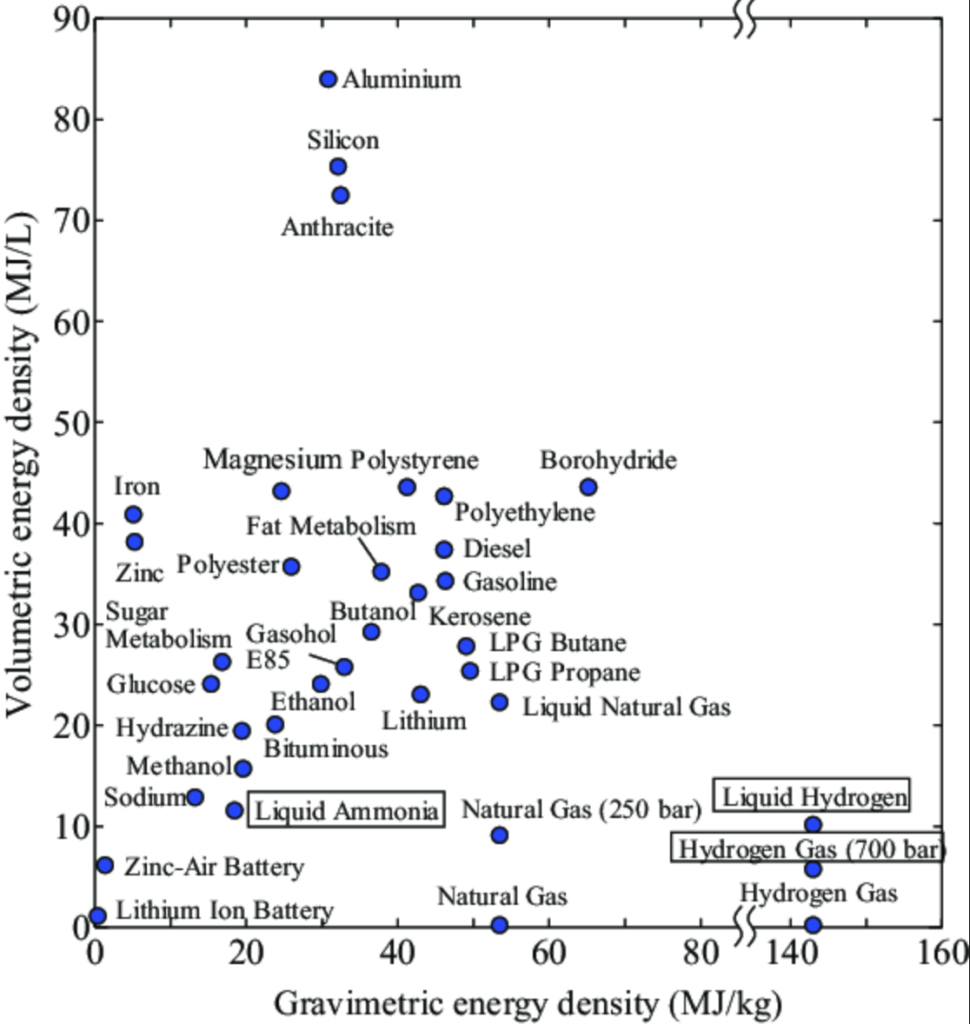
The calorific value of ammonia is 22.5 MJ/kg or about half that of diesel. In a normal engine, in which the water vapor is not condensed, the calorific value of ammonia will be further less (about 20% less). Overall, ammonia is far less energy dense than gasoline and diesel. Ammonia is also more difficult to ignite than gasoline and diesel. It is unclear whether ammonia-powered cars can compete with traditional ICEVs or even EVs.
As one of the most produced and transported chemicals, the infrastructure already exists. Still, ammonia as a motor vehicle fuel would require a significant change to current infrastructures, both in ammonia production and fuel storage and transportation.
Ammonia is a toxic and corrosive compound used extensively in agriculture and pharmaceutical, which raises concerns about safe handling and distribution. While ammonia is stored similarly to propane, fueling stations that can safely and effectively store and distribute ammonia will have several technical challenges and expensive.
Although ammonia is easier to transport and distribute than hydrogen, leakage is still a challenge that needs to be overcome. When released to the environment, though, it becomes a toxic gas. Liquid anhydrous ammonia expands ~850 times when released to ambient air and can form large vapor clouds.
Furthermore, ammonia engines release a significant amount of nitrogen into the atmosphere if they don’t maintain sufficient levels of high compression or boost. This means an improperly tuned or misfiring ammonia motor could potentially have devastating effects on health and the atmosphere.
Do ammonia-powered cars and trucks represent a new paradigm or just another new fad? Perhaps only time will tell.
]]>